


| Image | Product | Price |
|---|---|---|
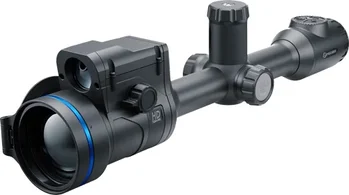 | Pulsar Thermion 2 LRF XL60 | Check Price |
At 100 yards, the Pulsar showed me water droplets on the grass. The budget thermals I was running at the same time could not even show me it was grass.
That is the whole question with the Pulsar Thermion 2 LRF XL60. It is a roughly $7,000 thermal riflescope, and you can buy a thermal for under $1,000. Is the difference worth that much money?
I spent almost six months with the XL60 and took it on more than a dozen range trips. I ran it on .22 LR and 5.56 rifles with barrels from 10.5 to 16 inches. In the same period, I also ran two budget thermals, the Goyojo GRS225RF and the Goyojo GRL335.
Short answer: yes, if you will actually use it. It is by far the nicest thermal I’ve ever played with, and I would pay full price for it. The biggest downside is the price itself. The second is that there is no mount in the box.
Pulsar sent us this unit, and we kept it in exchange for covering it.
Watch my full range session:

 AD
The fastest way to find a gun in stock near you.
Guns, ammo, optics, suppressors: one search, 4,200+ stores, live prices.
Pros and Cons
- More image detail than the budget Goyojos
- Keeps its detail when you zoom in
- Rangefinder within 1 to 3 yards of mine
- Very easy eye box and eye relief
- Stream Vision 2 app is easy to use
- About $7,000 MSRP
- No mount in the box
- Zero screen too dim in bright sun
- Deep menus with a lot to find
- I never got the remote to pair
Pulsar’s Specifications
These are Pulsar’s specifications for the Thermion 2 LRF XL60, not my measurements. NETD is how small a temperature difference the sensor can pick up (lower is better). Micro-OLED is the type of high-resolution display you look at through the eyepiece.
| Specification | Pulsar Thermion 2 LRF XL60 |
| MSRP | $6,999.97 |
| Pulsar SKU | 76575 |
| Sensor | 1024×768, 12 micron, uncooled |
| NETD | Sensor under 35 mK; system under 20 mK |
| Refresh rate | 50 Hz |
| Lens | F60 F/1.1 |
| Magnification | 2.5x to 20x (digital zoom) |
| Field of view | 11.7 degrees horizontal (20.5 m at 100 m) |
| Eye relief | 65 mm (2.56 in) |
| Display | 2560×2560 Micro-OLED |
| Detection range | 2,800 m (about 3,062 yd), deer-size target |
| Rangefinder | 905 nm, up to 800 m (875 yd), plus or minus 1 m |
| Batteries | Built-in APS5 4,900 mAh plus removable APS3 3,200 mAh |
| Rated runtime | 8 hours, built-in plus one APS3, at 72 F (22 C) |
| In the box | Two APS3 packs, APS charger, Bluetooth remote, USB-C cable, case; no mount |
| Mounting | Standard 30 mm rings |
| Recording | 1280×960 video and photo with audio; 64 GB built-in |
| Connectivity | Wi-Fi and Bluetooth; Stream Vision 2 app |
| Reticles and palettes | 10 reticles in 9 colors; 9 palettes |
| Zero profiles | 10 profiles, 10 distances each |
| Weatherproofing | IPX7 |
| Operating temperature | -13 F to 122 F |
| Recoil rating | .375 H&H and 12 gauge |
| Weight | 1.2 kg (42.3 oz, about 2.6 lb) with battery |
| Length | 17.4 in |
| Warranty | 3 years, 5 with registration |
How I Tested
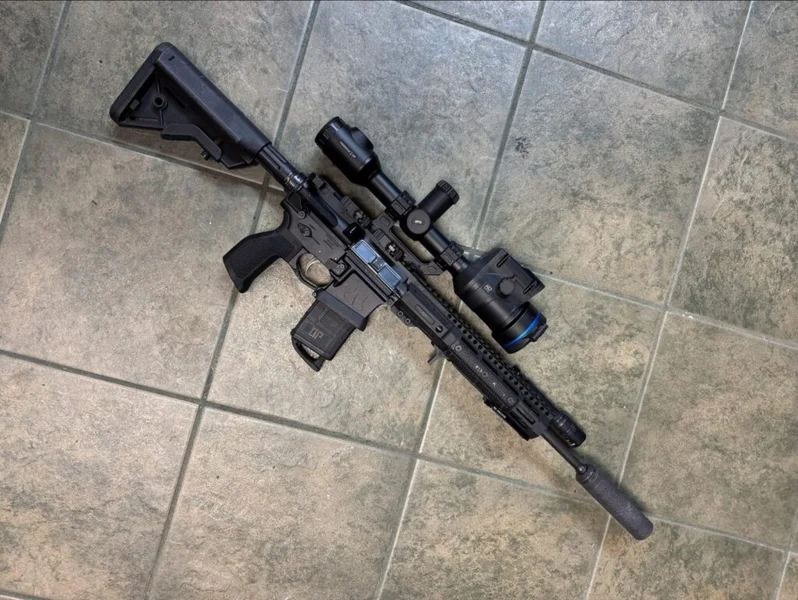
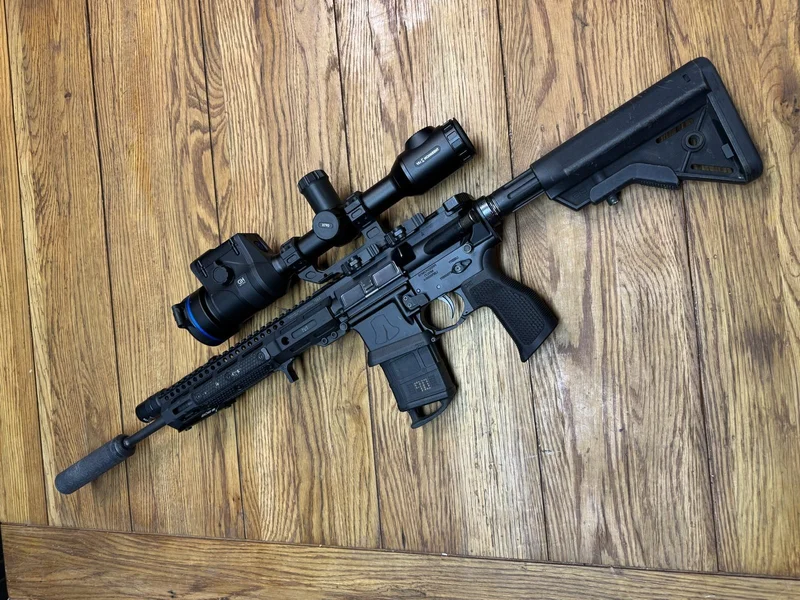
I had the XL60 for almost six months and more than a dozen range trips. It went on .22 LR and 5.56 rifles with barrels from 10.5 to 16 inches. In the video, it is on my lightweight Liberty Bell rifle with a Disavowed Group Bantam 5.56 suppressor, on a tripod.
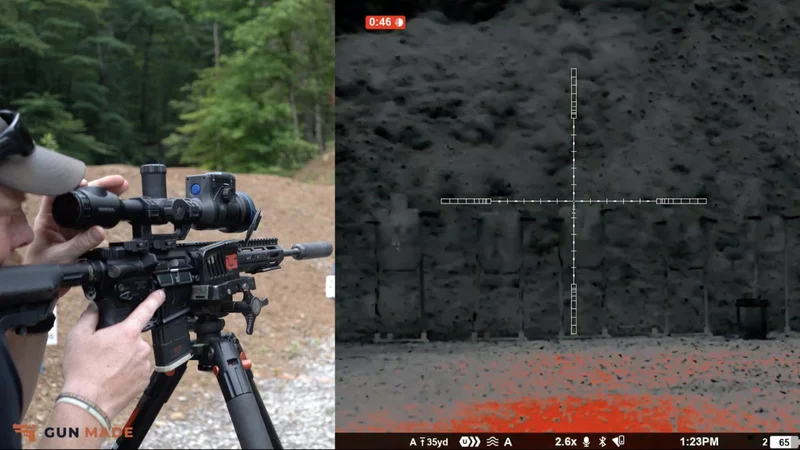
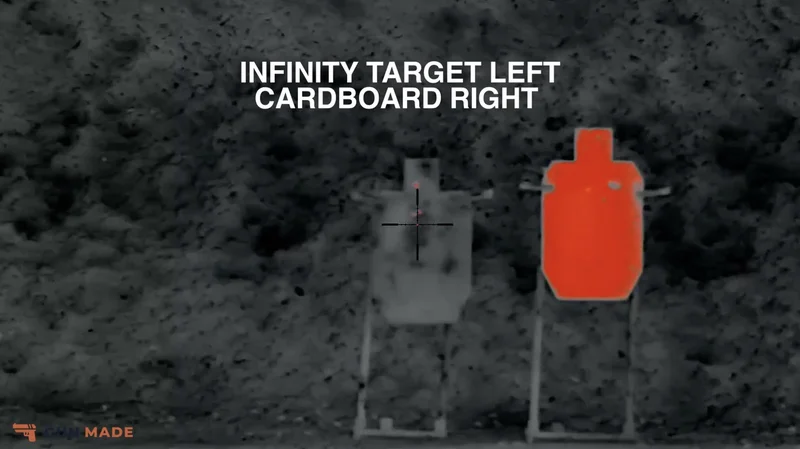
I zeroed it on an Infinity Targets rubber target. I checked the rangefinder on steel against a rangefinder I know is accurate. I used it in Tennessee summer heat, on a night hike, and in fog and rain. The whole time, I was also running the Goyojo GRS225RF and GRL335, both under $1,000.
What I did not test: the ballistic calculator (I am not a long-distance shooter or hunter), temperature extremes, transfer to a computer, or swapping zero profiles between rifles. We tried a few nights of hunting and had no luck, so there are no hunting results here. Firmware version not recorded.
Water Droplets on Grass
This is where the money goes. My clearest example is the grass at 100 yards, where the Thermion showed water droplets. The Goyojos could not show me it was grass at all.
The second difference is zoom. The Thermion kept its detail when I zoomed in.
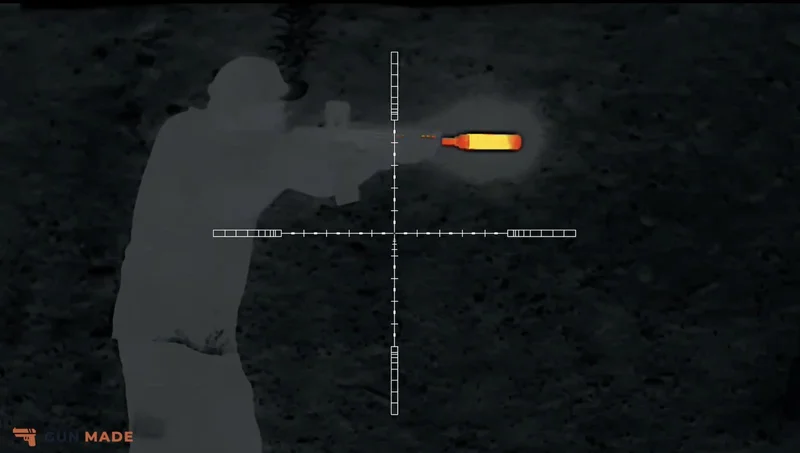
For palettes (the color schemes the scope uses to show heat), I prefer white hot or black hot. Black hot is my favorite. The colorful palettes made fine detail harder to see, especially at 100 to 140 yards.
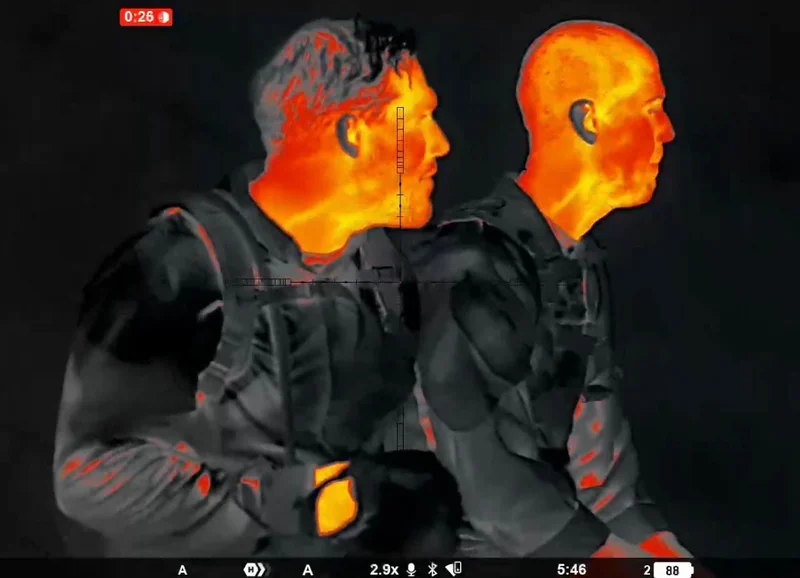
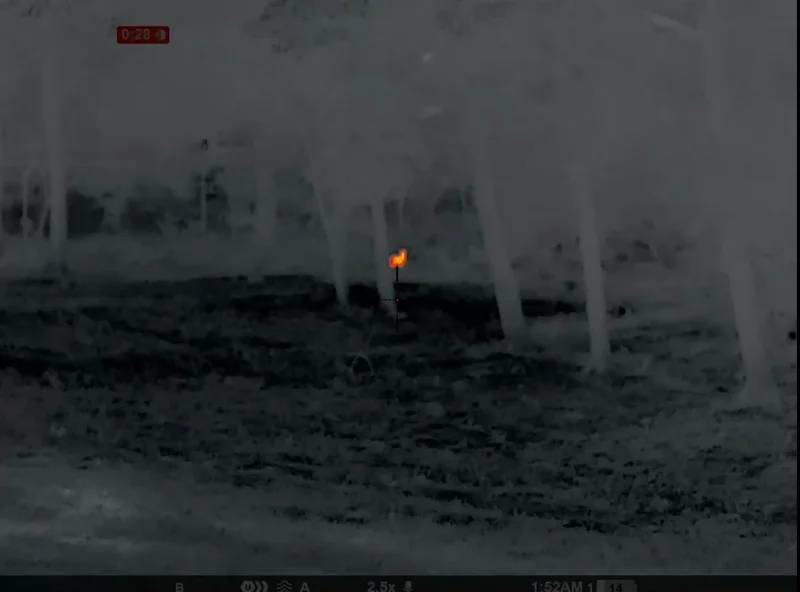
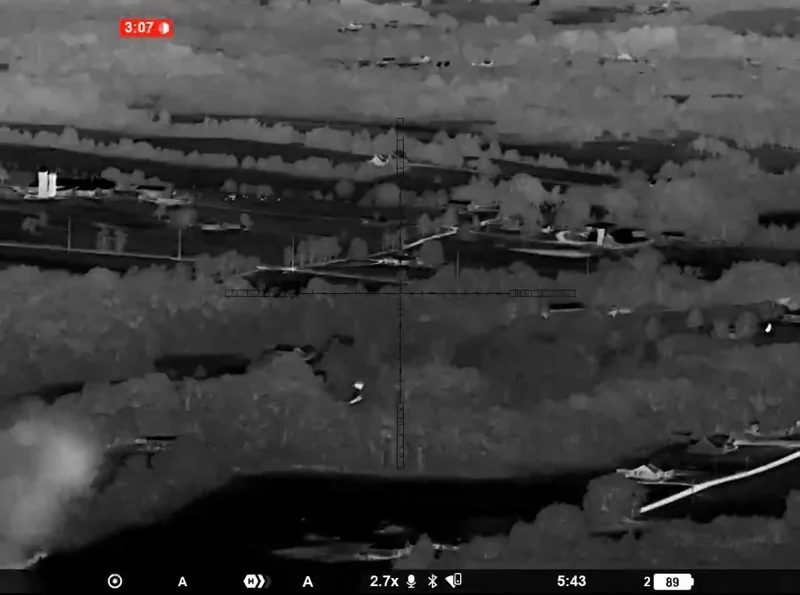
On a night hike with some of the guys, we looked out over a populated valley. I could see out several hundred yards and pick up heat signatures far out. My ability to tell what a heat signature was severely dwindled after 500 yards. I think Pulsar’s 2,800 m detection claim is close. One outdoor magazine’s test team estimated recognition at about 550 yards, which lines up with what I saw.
The Rangefinder Earned Its Keep
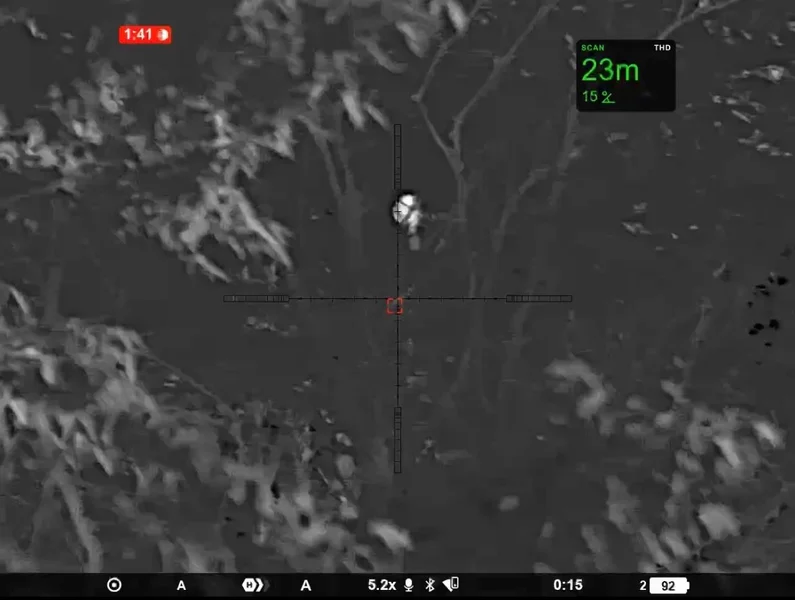
I ranged four steel targets between about 100 and 140 yards. The Thermion read 97, 98, 136, and 133 yards. My rangefinder that I know is accurate put them at about 97 to 98 yards and about 130 to 135 yards. That is within 1 to 3 yards.
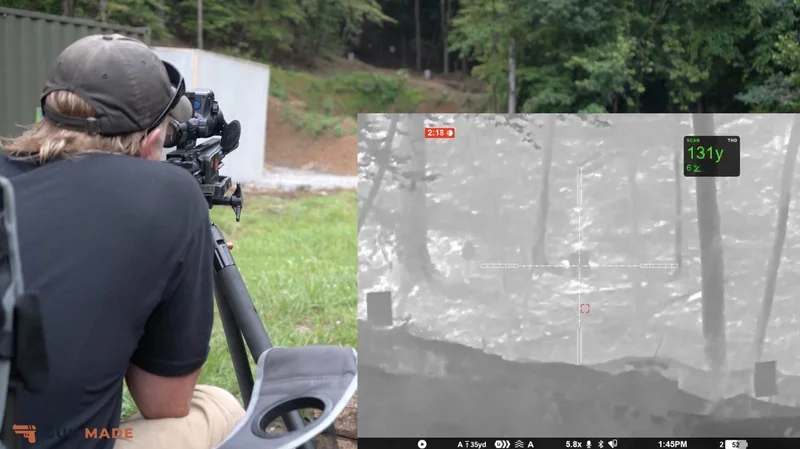
I also ranged an IDPA-size steel target at about 247 yards. I did not record that reading, so all I will say is that I tested it out to about 250 yards and it worked well. None of this proves Pulsar’s plus or minus 1 m spec. It just tells you the readings matched mine.
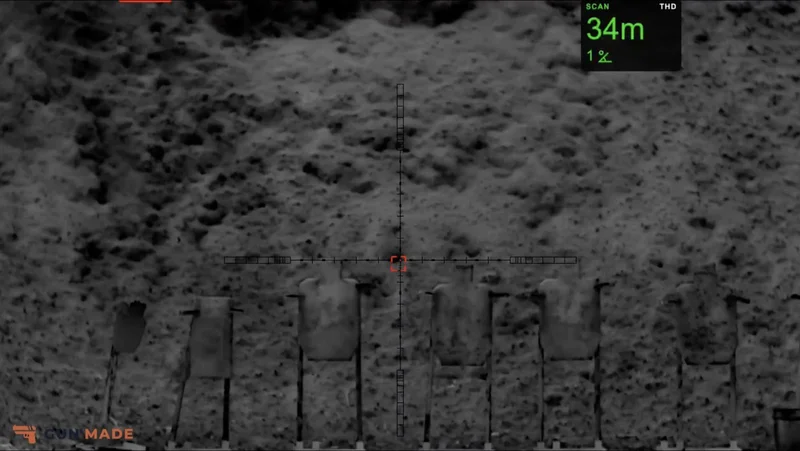
Zeroing: Fast, Except for the Sun
I was close in three shots and dialed in within about five. In the video session, I bumped the rifle while I adjusted the X and Y, and I called that zero close enough. On the zero check, the scope read 33 yards from just behind the 30-yard line.
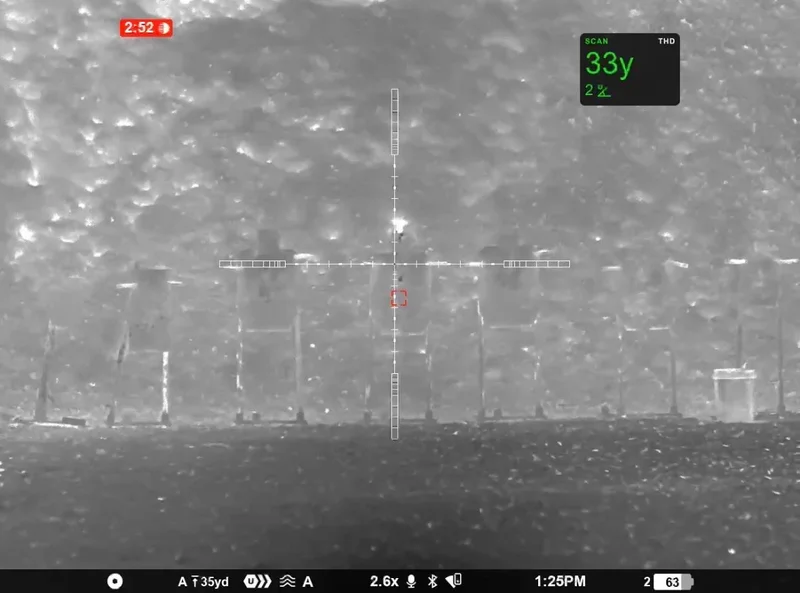
My biggest problem was the zero screen. It dims the display, and with the sun over my shoulder I could not get it bright enough to read.
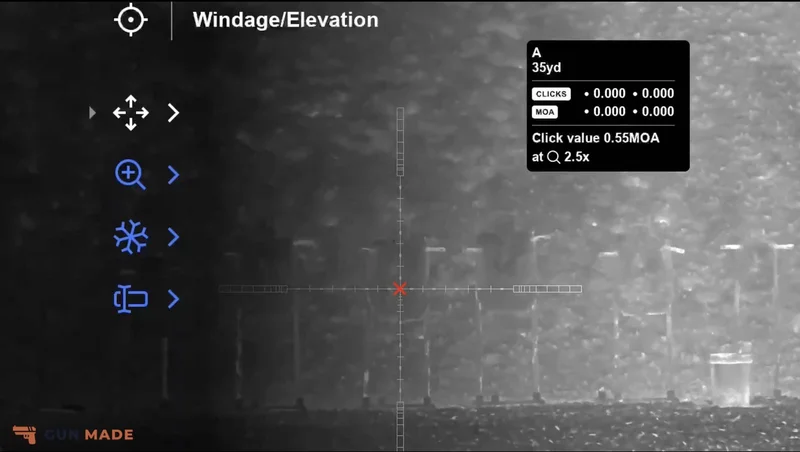
Pulsar’s manual describes a Freeze function. It lets you adjust on a still image, so you do not have to hold the rifle on target. If the sun is giving you trouble, Freeze is worth a try.
EXPERT TIP: Definitely use a rubber-style target. It is going to save you so much time. Rubber holds the heat from the bullet passing through much longer than paper or cardboard, so the hole stays visible longer.
The App Did Its Job. The Remote Did Not.
Stream Vision 2 is very easy to figure out. Live streaming worked easily. I like to watch on my phone and get on the scope when something pops up. Photos and video download to the phone fast. You don’t have to wait around like I have with some other thermals. Everything saves to the 64 GB of built-in memory, so there are no SD cards. I never connected it to a computer.
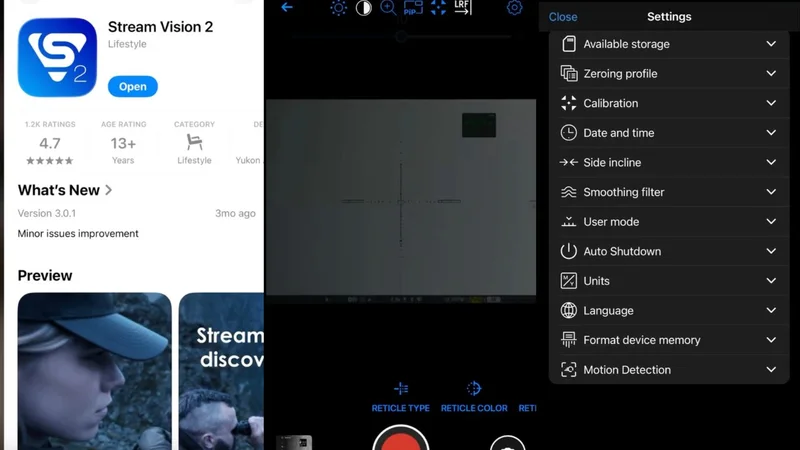
I never got the Bluetooth remote working. Pulsar’s manual says Bluetooth has to be on first, and then you pair the remote from the Bluetooth menu. Try that before you give up on it. I cannot tell you it works.
Batteries and Boot Time
A removable APS3 pack gave me about 2 to 3 hours. The internal battery gave me about 2 hours or a little less. Both depend on your settings. Pulsar rates the built-in battery plus one APS3 at 8 hours at 72 F.
My routine: keep the two removable packs charged in the range bag while the internal battery runs. The dual charger charges both packs at once. The USB-C port is under a cap.
From power-on, it takes about 15 to 20 seconds to be ready.
The Flaws
Price. It is the biggest downside. About $7,000 puts it out of reach, and most people will never get the chance to see or experience the amount of quality that the Thermion 2 has.
Then there is the mount, or the lack of one. No mount on a nearly $7,000 scope is absolutely absurd. I would like even some cheap scope rings. I used a Midwest Industries QD high-rise mount I already had, which goes on and off easily and moves between firearms. Budget for a 30 mm mount.
The rest are smaller. The zero screen is too dim to read with the sun over your shoulder. You will hunt for settings in the menus. I never got the remote paired. And coming off the bright screen, your eyes need a minute.
Who It’s For, and Who Should Skip It
Buy the XL60 if you want one of the best thermals, if you use a thermal on the range or farm all the time, or if you protect a homestead from varmints and predators. That means everything from a big coyote all the way down to a small mouse.
The reason to skip it is the price, the same downside I keep coming back to. If about $7,000 is out of reach, that does not mean going without. My advice is to get into some night vision or thermal at any budget. Our best night vision scopes guide is a good place to compare, and the two budget Goyojos are below.
Score Card
| Category | Score | Notes |
| Image Quality | 5/5 | Water droplets on grass at 100 yards; keeps detail when zoomed |
| Range and Detection | 4/5 | Heat signatures far out; ID severely dwindled after 500 yards |
| Rangefinder | 5/5 | Within 1 to 3 yards of my rangefinder |
| Battery | 4/5 | 2 to 3 hours per removable pack; two packs in the box |
| Ease of Use | 3.5/5 | Easy eye box and app; deep menus, dim zero screen, remote never paired |
| Value | 3.5/5 | Worth full price to me, but out of reach for most people |
| Overall | 4.2/5 | The nicest thermal I’ve used |
Accessories
A 30 mm mount. You need one, because none comes in the box. Mine is the Midwest Industries QD high-rise mount.
A rubber self-healing target. The bullet hole holds heat much longer than paper or cardboard, so you can see where you hit while you zero.
Alternatives
The main reason to look elsewhere is price.
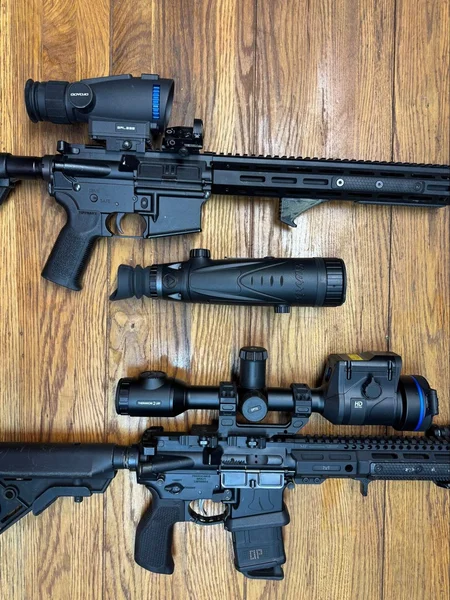
Goyojo GRS225RF. Under $1,000, with a built-in rangefinder. It is one of the two budget thermals I ran beside the Pulsar. Next to the Thermion, the Goyojos gave up image detail, held less detail in zoom, and did less from the app. Read our Goyojo GRS225RF review.
Goyojo GRL335. Also under $1,000, and the other budget unit I ran in the same period. The same image, zoom, and app trade-offs apply. Read our Goyojo GRL335 review.
Burris BTS35 v3. About $3,000 MSRP. I own one. It is a very nice scope for the price with a ton of great features.
For more options at every price, see our best thermal scopes guide. The XL60 is our best overall pick there.
Where to Buy
Pulsar Thermion 2 Lrf Xl60
667 listings availableFinal Verdict
This is the way thermal is supposed to be built. It is the first Pulsar product I have reviewed, and I’m hooked. After using it beside several other thermals, I see why that money gets you the next level abilities.
The price is real, and you still need to buy a mount. The zero screen fights the sun, and the menus take time. I would still pay full price for the XL60. If you use a thermal all the time on the range, the farm, or the homestead, this is the one to get.
Do you run a Pulsar? Let me know in the comments.